

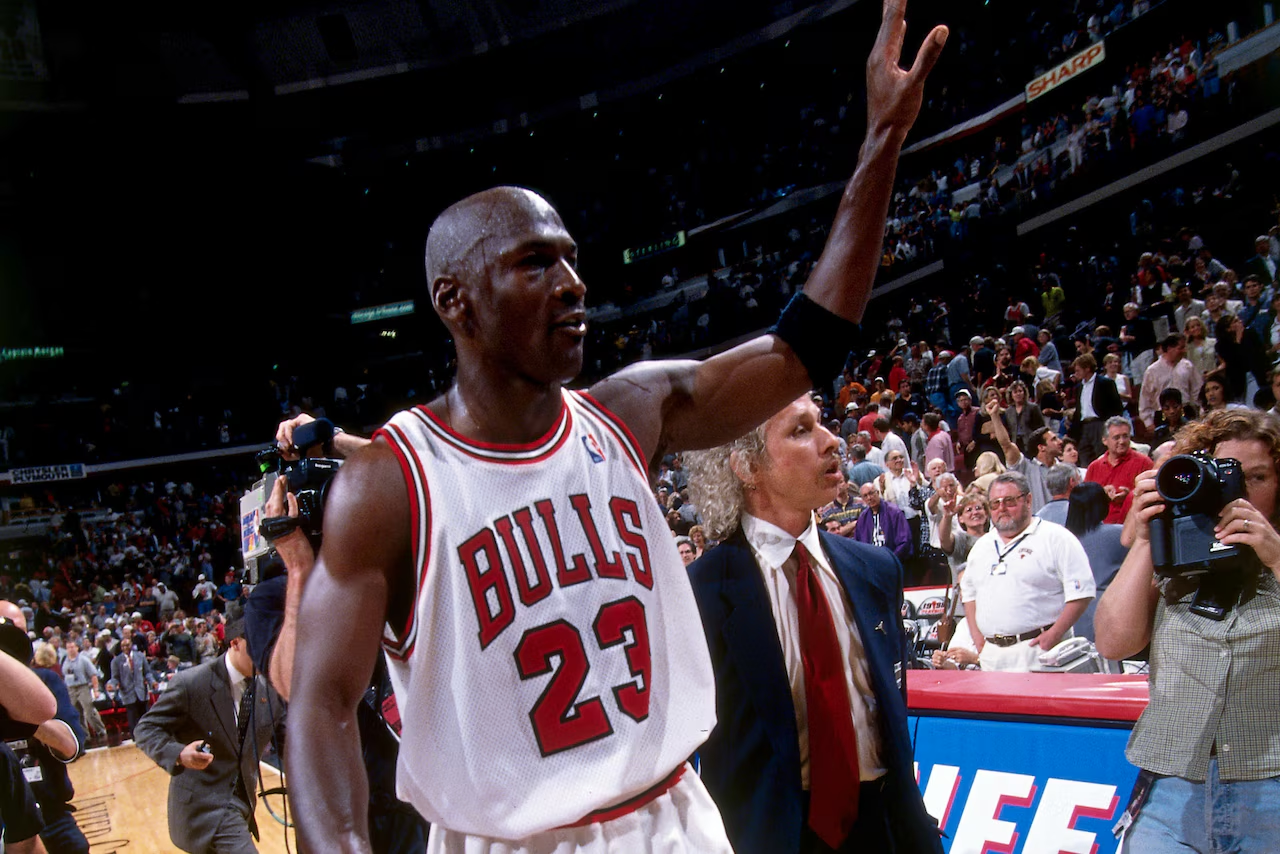
Most sports arguments burn hot for a week, then disappear into the next highlight cycle. The LeBron James legacy debate has lasted because it is not only about basketball; it is about what American fans believe greatness should look like. Some see Michael Jordan as the cleanest answer because six Finals trips with the Bulls became six titles, six Finals MVPs, and a myth that still feels untouchable. Others see James as the better modern case because his career has stretched across eras, teams, styles, and expectations in a way no star has matched. Readers who follow sports culture stories know this argument keeps returning because both sides have evidence, emotion, and memory on their side. The NBA’s official player bio lists James as the league’s all-time leading scorer with four titles, four regular-season MVPs, and four Finals MVPs, which gives his supporters plenty to stand on. Still, numbers alone do not settle the NBA greatest player debate. They explain why it refuses to end.
Why the LeBron James Legacy Debate Still Feels Personal
The argument feels personal because fans are not comparing two athletes in a lab. They are comparing childhood memories, local pride, highlight tapes, barbershop talk, playoff heartbreak, and the way basketball sounded in their own homes. Jordan and James became public mirrors for two different versions of excellence, and fans defend those versions like family history.
Fans are arguing about how they learned greatness
For many older fans, Jordan was not a player they discovered through clips. He was appointment television. A Bulls playoff game in the 1990s could pull families into the living room and turn Monday school hallways into debate floors. The shot over Craig Ehlo, the shrug, the Flu Game, and the final jumper in Utah formed a story with a clean shape. Rise, rule, vanish.
That shape matters. Jordan’s case feels complete because it has a beginning, a peak, and an ending that looked written for film. Basketball Reference lists him at 30.1 points per game for his career, the highest regular-season scoring average in NBA history, which supports the memory of him as a nightly pressure point. Fans who lived through that do not hear “six rings” as a stat. They hear a verdict.
James built a different kind of memory. He arrived as a teenager with national pressure on his shoulders, moved through Cleveland, Miami, Cleveland again, and Los Angeles, then kept adding chapters after most superstars would be reduced to ceremonial minutes. That makes his story less tidy. It also makes it harder to dismiss.
The Michael Jordan GOAT comparison is also a media memory test
The Michael Jordan GOAT comparison often depends on how a fan first consumed basketball. Jordan was sold through network TV, magazine covers, shoe ads, and VHS highlight reels. Scarcity helped him. When you saw Jordan, the moment felt bigger because you could not pull up every possession on your phone by halftime.
James played under permanent review. Every missed free throw, passive fourth quarter, chasedown block, and Finals loss became instant material. His failures stayed closer to the surface because the internet never lets a superstar age in peace. That is a strange disadvantage. More access does not always create more understanding.
A younger fan can watch James guard Derrick Rose, bully small forwards in Miami, run offense like Magic Johnson, and still finish above the rim in Los Angeles. That range is hard to fit into a simple phrase. The basketball legacy argument becomes messy because James is not one image. He is a long file with too many tabs open.
Rings, Numbers, and the Problem With Clean Scorecards
The next layer is where fans try to make the argument behave. Rings, MVPs, scoring titles, Finals records, playoff totals, All-NBA selections: these are meant to bring order. They help, but they also flatten the question. A scorecard can tell you what happened. It cannot always tell you what a player carried.
Why six Finals wins still carry unmatched weight
Jordan’s strongest case starts with Finals perfection. Six appearances with Chicago, six championships, six Finals MVP awards. That record is easy to remember and brutal to argue against. It turns the NBA Finals into a courtroom, and Jordan never lost the final case.
There is a reason this matters to American fans. Championships are the language of sports talk. A player can be brilliant for months, but June decides how many people remember the season. Jordan understood that stage and bent it around himself. His 1993 Finals scoring burst against Phoenix still feels rude in the best way: a superstar refusing to let a series breathe.
The non-obvious part is that the clean record can hide how much had to go right around him. Scottie Pippen became one of the best two-way players ever. Phil Jackson solved egos and spacing before “spacing” became a living-room word. Chicago’s front office found role players who accepted pressure without needing a spotlight. None of that weakens Jordan. It makes the six titles more real, not less.
Why longevity makes the NBA greatest player debate harder
James makes the clean scorecard wobble because his best argument is spread out. Basketball Reference lists him with 22 All-Star selections, 21 All-NBA selections, four championships, four MVP awards, and four Finals MVP awards. That résumé does not hit the ear like “six-for-six,” but it asks a harder question: how much credit should go to lasting excellence?
His playoff case is even harder to ignore. Basketball Reference’s playoff scoring list has James first and Jordan second, with James far ahead in total postseason points. Total stats can reward time on the court, yes. They can also reveal trust. Coaches kept asking James to solve playoff games because he kept being worth the burden.
The basketball legacy argument often misses that durability is not a side note. It is a skill. Staying elite through rule shifts, defensive schemes, roster changes, and aging legs is not luck wearing sneakers. In 2026, Reuters reported James had completed his 23rd NBA season and still remained central to the public GOAT conversation. That is not a normal career arc. It is a second career stacked on top of a Hall of Fame first one.
Style of Play Changes What Fans Think They Are Seeing
Stats tell part of the story, but style decides how fans feel. Jordan’s greatness looked direct. James’s greatness often looks like control. That difference splits the room because people tend to trust what feels dramatic over what feels managed.
Jordan made domination look final
Jordan attacked like a verdict. He did not have the size of James or the passing map of a point forward, but he made possessions feel personal. A jab step, a fadeaway, a hang in the air for half a second longer than the defender expected. The play often ended with the same message: you knew what was coming, and it still worked.
That matters because fans read body language. Jordan’s glare, shoulders, and slow walk after a big shot all fed the sense that he owned the moment before the ball left his hands. The Michael Jordan GOAT comparison gains power from that theater. It was skill, but it was also presentation.
The counterintuitive point is that Jordan’s myth can make his game seem simpler than it was. He was not only a scorer with a killer stare. He defended passing lanes, posted guards, moved without the ball, punished switches, and trusted the triangle when trusting it helped him win. The myth is loud, so the craft sometimes gets buried under the poster.
James made control look like problem-solving
James often wins the mind before he wins the possession. He reads the second defender, shifts the weak-side tag, waits until the corner help leans, then throws a pass most players notice too late. That style can look less ruthless than Jordan’s, even when it breaks a defense in a deeper way.
Think about Game 7 of the 2016 Finals. The chasedown block on Andre Iguodala became the frozen image, but the wider achievement was stranger: James dragged Cleveland through a 3-1 comeback against a 73-win Warriors team. That series gave his supporters a moment with Jordan-level emotional force. It was not perfect Finals math. It was rescue work.
This is where modern basketball analytics explainer would help readers see the split. James creates value in ways that do not always look like a final shot. He bends matchups, controls tempo, finds role players, and covers holes in roster design. Jordan made defeat feel sudden. James often makes it feel slowly trapped.
The Real Split Is Culture, Not Math
After the rings and numbers, the fight becomes cultural. Fans are deciding what kind of greatness they want to reward. One side prizes the clean peak. The other prizes the long burden. Neither is pretending. They are measuring from different emotional starting lines.
Older fans protect the standard they grew up with
Older fans can sound stubborn, but many are protecting a standard that felt earned in real time. They watched Jordan fail against Detroit, gain strength, trust teammates, then break through. That arc taught them greatness meant taking the scars, staying with the climb, and finishing the job without public career detours.
That view has a fair core. Jordan’s Bulls did not need a decade of explanation. They won, repeated, stepped away, returned, and repeated again. Even people who rooted against Chicago understood the line. In a sports culture that loves clean endings, Jordan gave America the cleanest one.
Still, nostalgia can sand off the rough parts. Jordan had playoff losses before the titles. He had front-office tension. He had teammates who could absorb hard coaching and harder standards. Remembering him as pure inevitability may feel good, but it turns a hard career into a marble statue.
Younger fans trust survival across eras
Younger fans often see James as the more complete answer because they watched him live under harsher daily judgment. He carried weak Cleveland teams, formed a Miami superteam, returned home and won the city’s first NBA title, then won again in Los Angeles. Each chapter asked for a different version of him.
That matters in the NBA greatest player debate because the league itself changed under his feet. Defenses got faster. Three-point volume exploded. Wings became playmakers. Big men started shooting from deeper range. James did not belong to one era. He kept editing his game until several eras made room for him.
For readers building a broader NBA rivalry history guide, this is the part that should not be skipped. The argument is not only “who was better?” It is also “which kind of career would be harder to repeat?” Jordan’s peak may be the sharper mountain. James’s span may be the longer impossible road.
Conclusion
No single stat can end this argument because fans are not asking one question. They are asking whether basketball greatness should be judged by peak command, career weight, Finals purity, adaptability, cultural impact, or the fear a player created in the biggest moments. Jordan still owns the cleanest championship case and the most powerful winning image the sport has produced. James owns the strongest longevity case and the broadest proof of elite value across changing basketball worlds. That is why the LeBron James legacy debate keeps dividing fans instead of fading into old sports noise. The better way to watch it is not to force one man to erase the other. It is to admit that the sport was lucky enough to produce two different answers to the same impossible question. Pick your side if you want, but do not shrink the argument to a bumper sticker.
Frequently Asked Questions
Why do fans still compare LeBron James and Michael Jordan?
Their careers represent two different ideas of greatness. Jordan offers the cleaner peak and perfect Finals record. James offers unmatched length, adaptability, and all-time production. Fans keep comparing them because both cases are strong enough to survive the other side’s best argument.
Is Michael Jordan’s 6-0 Finals record the strongest GOAT argument?
It is the simplest and strongest Jordan point. Six Finals, six titles, and six Finals MVPs create a standard no modern superstar has matched. The only caution is that team context, league era, and playoff path still matter when judging one player.
Does LeBron James have a better all-around career than Jordan?
He has the stronger all-around longevity case. James has scored, passed, rebounded, defended, and led offenses across more seasons than any superstar in this debate. Jordan’s peak still carries more Finals weight, so the answer depends on what you value first.
Why do younger NBA fans often choose LeBron over Jordan?
They watched James adapt in real time. He won with different teams, handled constant media pressure, and stayed elite long after most stars fade. To younger fans, that long survival across eras feels harder than a shorter but cleaner peak.
Why do older NBA fans often choose Jordan over LeBron?
They saw Jordan turn the league into his stage during the 1990s. His title runs felt final, and his best moments had a rare sense of control. For many older fans, greatness means owning the biggest stage without a Finals loss.
Who had the better playoff legacy, LeBron or Jordan?
Jordan has the cleaner Finals record and higher Finals scoring aura. James has the deeper total playoff résumé, with more years as a primary engine. Jordan’s case is sharper. James’s case is wider. The better answer depends on whether you prize peak or volume.
Does team switching hurt LeBron’s case against Jordan?
Some fans hold it against him because Jordan’s Bulls story feels more traditional. Others see James’s moves as proof he could win in different settings. Team switching hurts his case only if you believe staying in one main system should carry special weight.
Can the LeBron vs Jordan debate ever be settled?
No, because it is built on values as much as facts. A fan who prizes Finals perfection will lean Jordan. A fan who prizes longevity and role flexibility will lean James. The debate lasts because both standards are fair, but they reward different careers.